

I’ve been running a little experiment in a small Robinhood account, and I wanted to write it down while the paint is still wet.
We’re talking lunch money. About twenty dollars. That is real money, and I treat it that way. It is also pocket change. If a trade goes wrong, I will feel a little foolish and I will not miss a house payment. That’s the whole point. I wanted to practice discipline in a place where the lesson costs almost nothing.
Every week I go in with one goal: learn something. Not to get rich by Friday. Not to prove I can pick stocks. Just to get a little better at keeping a promise I already made to myself.
Clear boundaries, on purpose
I gave my AI assistant a connection to that Robinhood account, and I gave it very clear, very small boundaries. In plain words, it can watch prices and follow a plan I approved. It does not get to wander.
I review and approve each plan before the assistant can buy anything. I swing trade, not day trade. A plan is meant to last a few days, not a few minutes. And I only run one plan at a time. That last part used to be “one trade per week.” I changed it today, because a trade can close early and leave a lot of week still sitting there. The assistant even warned me about that. Cash that frees up early can start looking like an invitation to force the next idea. So the new rule is simpler. One plan at a time, and every new entry still has to earn its way in. If it doesn’t meet the plan, we skip.
Skip is a position. Sitting in cash is a decision, not a blank space on the calendar. One clean idea beats forcing trades just to feel like I did something.
The Rocket Lab plan
This week’s plan was for Rocket Lab, ticker RKLB.
I bought at an average of about $59.43. The target was about $66.56. I had a stop in place, and I had an exit by Friday if the target had not been hit. Simple. Written down. Approved by me before the first share was bought.
Today it hit the target.
The assistant sold at $67.00. That’s about a $3 gain, or 12.7%. For lunch money, that’s a nice little result. I’m not going to pretend I wasn’t glad to see it.
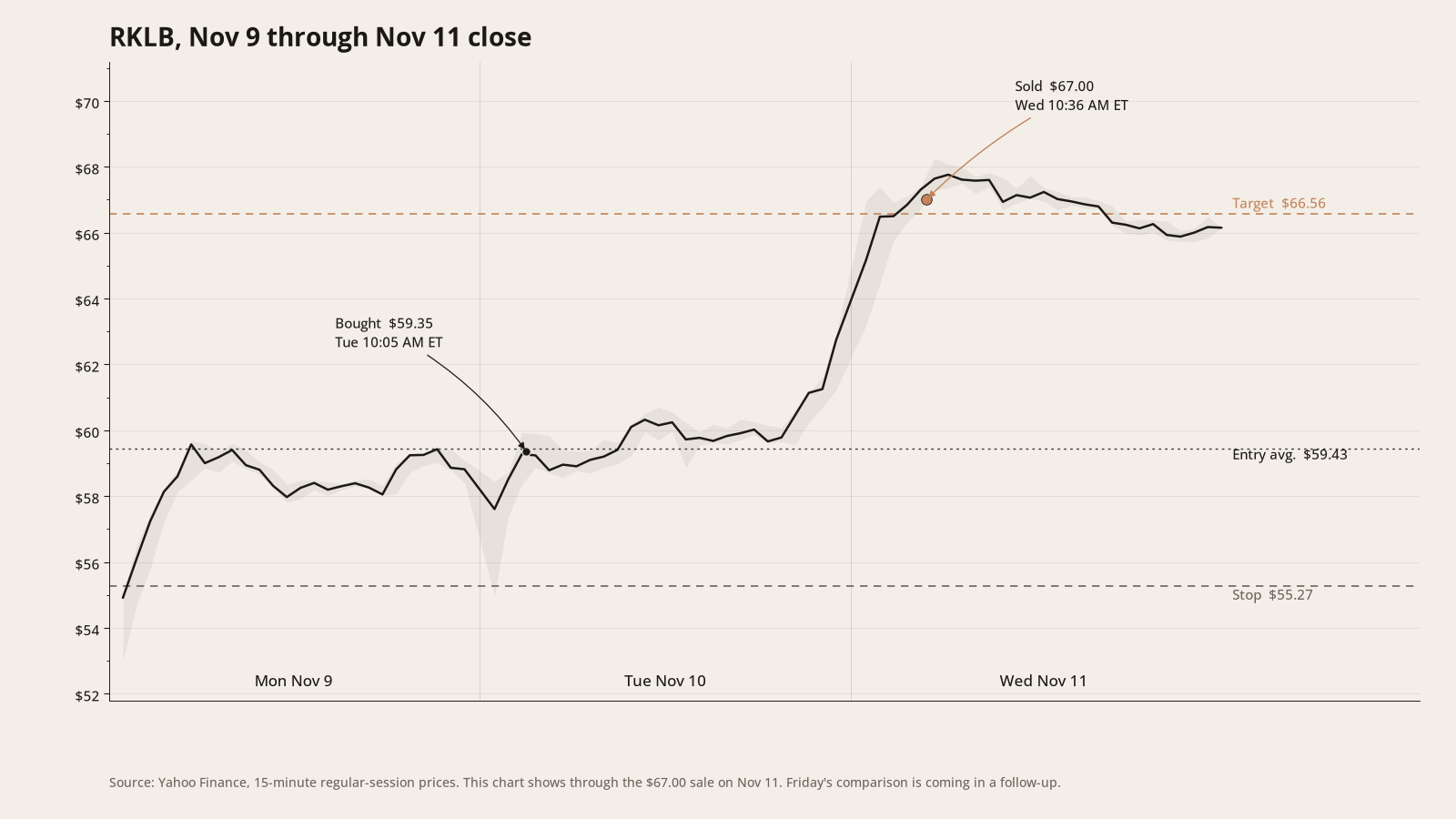
Then the other thought showed up, right on schedule. What if I let it ride? The stock was still climbing. Maybe I was leaving money on the table. Maybe the smart move was to hang on and see.
I’ll be honest. That thought is a very smooth talker.
The plan you write in the quiet is the one that counts
I stuck with the plan.
Not because I’m unusually disciplined. I’m not. I stuck with it because I had already decided, in the quiet, what “done” looked like. A pre-written take-profit and a stop beat hoping for more. Hoping is not a strategy. “Let it ride” sounds like one, but most of the time it’s just emotion in a nicer jacket.
I learned the other side of that earlier, on an energy trade I cut sooner than my pride wanted to. Getting out early stung a little. It also saved me from worse pain. The finish line is the one you marked before the race, not a new one you invent because the crowd started cheering, or because the chart started going the wrong way and you wanted to be right.
I will not know until later whether selling RKLB at $67 was the “right” call in hindsight. So I asked my assistant to track how Friday’s close compares to that sale. If it keeps running, I’ll see it. If it fades, I’ll see that too. I’m going to share how that turns out. I don’t want to only tell the story when it makes me look smart.
Hype, options, and staying in my lane
That same morning, I had asked a different question. Is Rocket Lab really an “AI stock,” the way the conversation around it sometimes sounds? What I found was more grounded than the buzz. There is a real contract in the mix, a 2029 Neutron launch booked by Starcloud, which Rocket Lab included in its Nov 9 announcement of more than $515 million in Neutron deals, and there is also a lot of narrative. On the earnings call, Peter Beck was measured about space data centers: smaller, defense-focused ones may be doable, but the big economic questions are still unsolved. That was a useful reminder. A good story is not the same thing as a good business, and I want those two separated before I risk even lunch money.
I also looked at options, mostly to understand them. I learned something basic and important: one contract covers 100 shares. At my budget, that doesn’t buy a careful, small idea. It buys long shots. So I set guardrails. Options, if I use them at all, are capped at a quarter of the account. I get a risk warning first. And the assistant needs my explicit OK, every time. No shortcuts, even when the idea feels exciting.
At the end of the week I get a report of lessons learned. That’s my favorite part, if I’m honest. The trade is the drill. The notes are the practice.
None of this is a system I’m handing you. I’m not telling you to buy Rocket Lab, or to copy my rules, or to treat a small experiment like a shortcut. This is not financial advice. It’s one guy, a small Robinhood account, and a set of boundaries I can actually keep.
If you’ve been curious about using AI for something practical, maybe the way in is smaller than you think. Pick a practice with almost no downside. Write the rules when your head is clear. Then see if you can still honor them when things start moving.
I’ll let you know how Friday looks against that $67 sale.
For now, I’m treating the plan as the win. The three dollars was just the ribbon at the finish line.
