
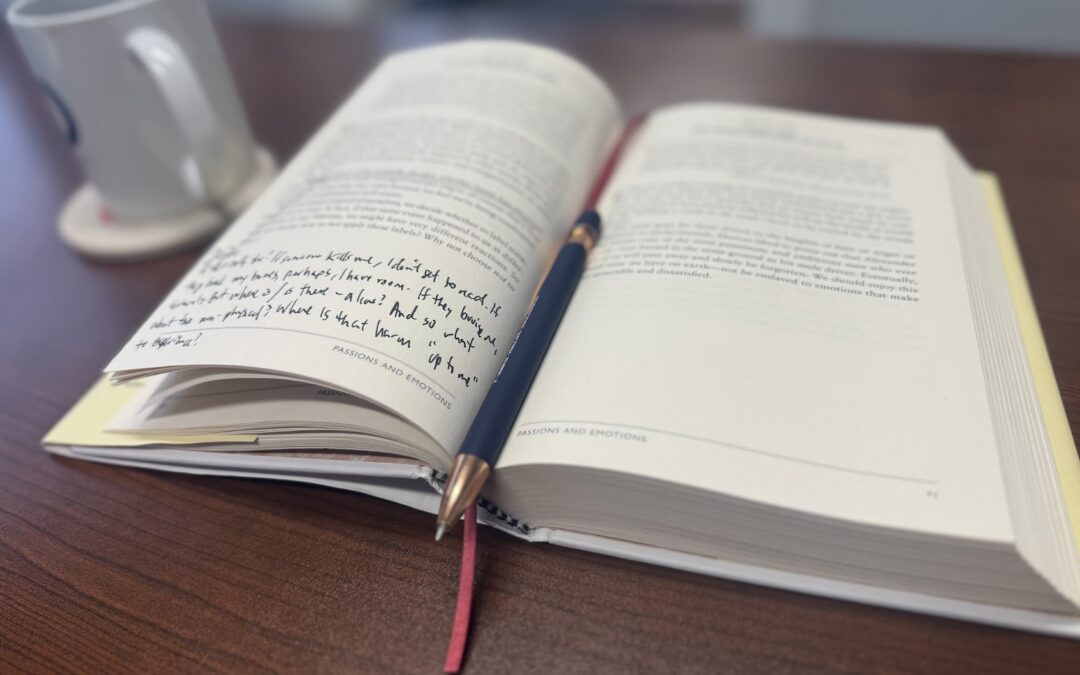
Each morning at the office, before emails, before meetings, before the quiet hum of problem-solving begins, I sit down with a small, steady ritual: a few minutes with The Daily Stoic. The book sits on my desk like a fixed point — a quiet counterweight to the noise of deadlines, decisions, and the unpredictable nature of running a business and living a full life.
Today’s reading was titled, “The Real Source of Harm.” One line in particular stopped me:
“Keep in mind that it isn’t the one who has it in for you and takes a swipe that harms you, but rather the harm comes from your own belief about the abuse… make it your first response not to be carried away by such impressions.”
And later:
“Our reaction is what actually decides whether harm has occurred.”
That’s a strong claim. Maybe even an unsettling one.
Because on the surface, it sounds almost too clean for the real world.
So I did what I tend to do when a thought pokes at me — I didn’t just underline it. I argued with it. Right there in the margins.
Is this really true?
If someone kills me, I don’t get to react.
If they break my bones, I have some room, perhaps.
But what about the non-physical?
Where is that harm “up to me” to experience?
That tension sat with me longer than the coffee did.
The Stoic idea, at least as Epictetus presents it (and as The Daily Stoic echoes), is not that nothing bad ever happens. It’s not pretending that pain, injustice, or loss aren’t real. Instead, it’s drawing a sharp line between the event and the interpretation of the event. Between what happens and what we decide it means.
But that line is harder to live with than it is to read.
Because in real life, harm doesn’t always come in dramatic, physical forms. Most of the harm we feel in a day is quieter. Subtle. Non-physical. A tense conversation. An email that feels sharp. A misunderstanding. A criticism. A decision that didn’t go the way we hoped. A comment that lingers longer than it should.
No broken bones.
No visible wounds.
Yet somehow, it still hurts.
And that’s where the reading becomes less theoretical and more personal.
If someone insults me and I never hear it, did it harm me?
If someone sends an angry email and I interpret it as an attack, did the harm come from the words — or my belief about the words?
If a situation unfolds and I immediately label it as “bad,” “unfair,” or “wrong,” how much of that harm is the event… and how much is the label?
The Stoics would say the label matters more than we want to admit.
That conclusion makes me uncomfortable — and I think that discomfort is actually the point.
Because I don’t believe the reading is saying that harm isn’t real. Physical harm is real. Loss is real. Injustice is real. To pretend otherwise would be detached from reality. But I do think it’s challenging a deeper habit: our tendency to immediately internalize and categorize every experience as harmful the moment it feels unpleasant.
“Our reaction is what actually decides whether harm has occurred.”
That line bothered me at first. It felt too absolute.
But the more I sat with it, the more I realized it applies most powerfully to the non-physical parts of life — the parts that dominate a modern workday and, honestly, a modern mind.
In the office, I’m not dodging physical threats.
I’m navigating expectations. Communication. Pressure. Decisions. Relationships. Outcomes.
And in those spaces, interpretation is everything.
A delayed reply can feel like rejection.
A critique can feel like personal attack.
A challenge can feel like confrontation.
A setback can feel like failure.
Yet the event itself is often neutral until I assign meaning to it.
That doesn’t mean the feeling is fake. It means the narrative is powerful.
One thing I wrestled with in my margin note was the extreme example — death, broken bones, undeniable physical harm. In those cases, reaction isn’t optional in the same way. Pain exists whether I philosophize about it or not. That’s where Stoicism, if misunderstood, can sound detached or unrealistic.
But I don’t think the passage is aimed at those extremes.
It’s aimed at the everyday impressions that quietly shape our inner state.
The offhand remark.
The unexpected conflict.
The internal frustration.
The mental spiral that starts with one small event and grows into a story.
That’s where the “real source of harm” often lives — not in the event itself, but in the unchecked momentum of interpretation.
And if I’m honest, this is where the struggle becomes personal.
I care deeply about justice, about resolution, about things being set right. When something feels wrong, my instinct is not to shrug it off but to analyze it, weigh it, and often carry it longer than necessary. That instinct has strengths. It drives responsibility. It drives ownership. It drives thoughtful leadership.
But it also means I can unintentionally amplify harm by revisiting it mentally long after the moment has passed.
Not because the event is still happening.
But because the impression is still active.
That realization doesn’t lead me to a simple conclusion like, “Just don’t care.” That would be shallow. And it wouldn’t be true to how I’m wired.
Instead, my conclusion is more nuanced.
Events happen.
Interpretations follow.
Suffering often compounds in the space between the two.
The Stoic response is not emotional suppression. It’s emotional discipline. A pause before labeling. A moment of distance before reaction. A willingness to ask: “Is this harm — or is this my impression of harm?”
That question alone changes the temperature of a situation.
It slows escalation.
It creates space.
It restores agency.
Another line from the reading mentions not being “carried away by such impressions.” That phrase stuck with me more than anything else. Because being carried away is exactly how most internal harm unfolds — not in one dramatic moment, but in a series of small, unexamined reactions.
One thought becomes a story.
The story becomes a narrative.
The narrative becomes a mood.
And the mood colors the entire day.
All from an initial impression that may not have deserved that weight.
My final takeaway from this morning’s reading isn’t that harm is imaginary. It’s that harm is often layered. There is the external event, and then there is the internal amplification. Stoicism is less about denying the first and more about mastering the second.
And that’s where the book earns its place in my morning routine.
Not because it gives me easy answers.
But because it gives me better questions.
Before reacting.
Before labeling.
Before deciding something is “bad.”
I can pause and ask:
What actually happened?
What am I adding to it?
And where, exactly, is the harm occurring?
Some mornings the answer is clear.
Other mornings — like today — the struggle is the lesson.
And maybe that’s the quiet value of reading The Daily Stoic at the start of a workday. It doesn’t remove tension. It reframes it. It doesn’t erase difficulty. It equips perspective.
Not perfectly.
Not instantly.
But steadily.
One page.
One margin note.
One examined impression at a time.
