
Heads up: some links in this post are Amazon affiliate links. If you buy through them, I may earn a small commission at no extra cost to you. As an Amazon Associate I earn from qualifying purchases.
Most motorcycles in Indiana go to sleep around Halloween. Mine doesn’t want to.
Every fall I go through the same little ritual. The leaves turn, the mornings get crisp, and I start doing the math in my head on how many more rides I can squeeze in before the bike gets parked in the garage under a cover until spring. Five months of looking at it. Five months of a battery tender blinking at me like it’s judging me.
This year I asked a different question. What would it take to just keep riding? Not on the nasty days. I’m not crazy. But on the cold, dry, clear mornings that make up a lot more of an Indiana winter than you’d think. And if I’m going to spend real money on heated gear to do it, does winter motorcycle commuting ever pay for itself compared to driving my diesel truck to work?
So I did what I do with most big questions lately. I put my AI research assistant, Shoop, on it, and asked him to do all the homework: the gear, the prices, the electrical side, the weather history and the break-even math. Then I sat down to write about why I wanted to ask the question in the first place.
This is a long one. Grab a coffee. A hot one.
Why I want to ride my motorcycle all winter
Let’s start with the part that has nothing to do with spreadsheets.
The commute becomes the best part of the day
My commute is about 45 minutes each way, three days a week. In the truck, that’s 45 minutes of radio, a little bit of zoning out, and a lot of thinking about my inbox before I even get there.
On the bike, it’s different. You can’t half pay attention on a motorcycle. You’re present. You smell the wood smoke from a farmhouse chimney. You feel the temperature drop when you dip into a valley by the creek. You see the sunrise instead of a windshield.
I show up to work with a clear head. I come home and the day is already processed by the time I pull in the driveway. That’s worth something. Honestly, it might be worth more than the fuel savings. But we’ll get to those.
A bike that rides is a healthier bike
Motorcycles don’t love sitting. Batteries go weak, fuel gets stale, seals dry out, and tires flat spot. My 2022 Indian Chief Dark Horse is a machine that was built to be ridden, not stored. Riding it through the winter, even a couple of times a week, keeps everything moving and keeps me from that springtime surprise of a dead battery and a bike that runs rough for the first few rides.
You find your people
There’s a whole community of cold weather riders out there, and they are some of the friendliest folks you’ll meet. You see one at a gas station in January and there’s an instant nod. Maybe a laugh. We both know we’re a little bit nuts. That shared grit is fun. It’s the same feeling as the last mile of a long race where everyone around you is hurting and nobody is quitting.
Being honest about safety
Now let me be really clear about something, because I want my family reading this too.
Heated gear keeps you warm. It does NOT keep you upright.
No jacket on earth fixes ice. Snow, slush, sleet, freezing rain, black ice and refreeze mornings are no ride days for me. Period. Cold tires also have less grip, salt and brine are slick and nasty, and the sun is low and in everybody’s eyes. Deer are out in the dark. I’m not riding to prove anything. When the road says no, the truck gets the miles and I’m fine with that.
The goal is not to ride every day. The goal is to ride the good days that I’ve been giving away every winter for no reason other than being cold.
The research: what heated gear does a winter commute need?
Here’s the setup Shoop priced out. A few quick ground rules on how he built it:
- Prices are what each store listed on November 7, 2026. They will change, so check before you buy.
- I wear a 2XL Tall where I can get it, so the list leans toward tall cuts for the upper body. Pants, gloves and boots depend on your own sizes.
- I already own a full face helmet, so no helmet is included.
- Everything is designed to plug into the bike’s 12 volt system through one fused harness and one dual controller.
The value kit: about $2,090 all in
This is the build I’d actually start with. It’s built around Gerbing’s 12V heated layers under a waterproof, armored tall shell.
| Type | Item | Store | Price | Why it’s here |
|---|---|---|---|---|
| Outer shell | Fly Racing Street Terra Trek Jacket, Black 2XL Tall | RevZilla | $299.95 | Waterproof HydraGuard shell, CE shoulder and elbow armor. Back protector sold separately. Was a closeout with 2 left when checked. |
| Heated layer | Gerbing 12V Heated Jacket Liner 2.0 | Gerbing | $279.99 | 7 heat zones, 6.4 A. No tall size exists, so this is a standard 2XL. |
| Heated layer | Gerbing EX Pro 12V Heated Pants | Gerbing | $249.99 | Waterproof shell with removable heated liner, 3.6 A. Knox knee armor, no hip armor. Runs small. |
| Heated layer | Gerbing GT5 Hybrid 12V Heated Gloves | Gerbing | $169.99 | Aquatex waterproof membrane, 2.2 A per pair. Plugs into the liner sleeves. Runs about a size large. |
| Heated layer | Gerbing 12V Heated Sock Liners | Gerbing | $79.99 | 1.0 A per sock. Plug into the pant cuff. |
| Electrical | Gerbing 12V Wireless-Ready Dual Controller | Gerbing | $69.99 | Two channels, 192 W (16 A) max for one rider. |
| Electrical | Gerbing 12V Battery Harness with Fuses | Gerbing | $11.99 | Fused harness. Gerbing's chart puts this kit on a yellow fuse. |
| Electrical | Gerbing 12V Wireless Temp Controller Remote | Gerbing | $24.99 | Bar-mounted remote for the dual controller. Nice to have. |
| Boots | Indie Ridge The Crow 7.1 | Indie Ridge | $195.00 | Waterproof, CE EN 13634 Level 2. |
| Base layer | Carhartt Force Midweight Base Layer Crew, Tall | Big Ray’s | $49.99 | Thin synthetic waffle knit that comes in a tall cut. |
| Base layer | KLIM Aggressor 2.0 Base Layer Pant | Scheels | $59.99 | Synthetic base layer under the heated pants. |
| Neck | Alpinestars Neck Warmer | RevZilla | $24.95 | Plugs the cold gap between helmet and collar. |
| Head | Alpinestars Open Face Balaclava | RevZilla | $34.95 | Thin under-helmet layer. $7.99 shipping on the RevZilla order. |
| Visor | EK USA Cat Crap Anti-Fog Balm, 0.5 oz | Amazon | $11.42 | Check your helmet maker's shield care guidance first. |
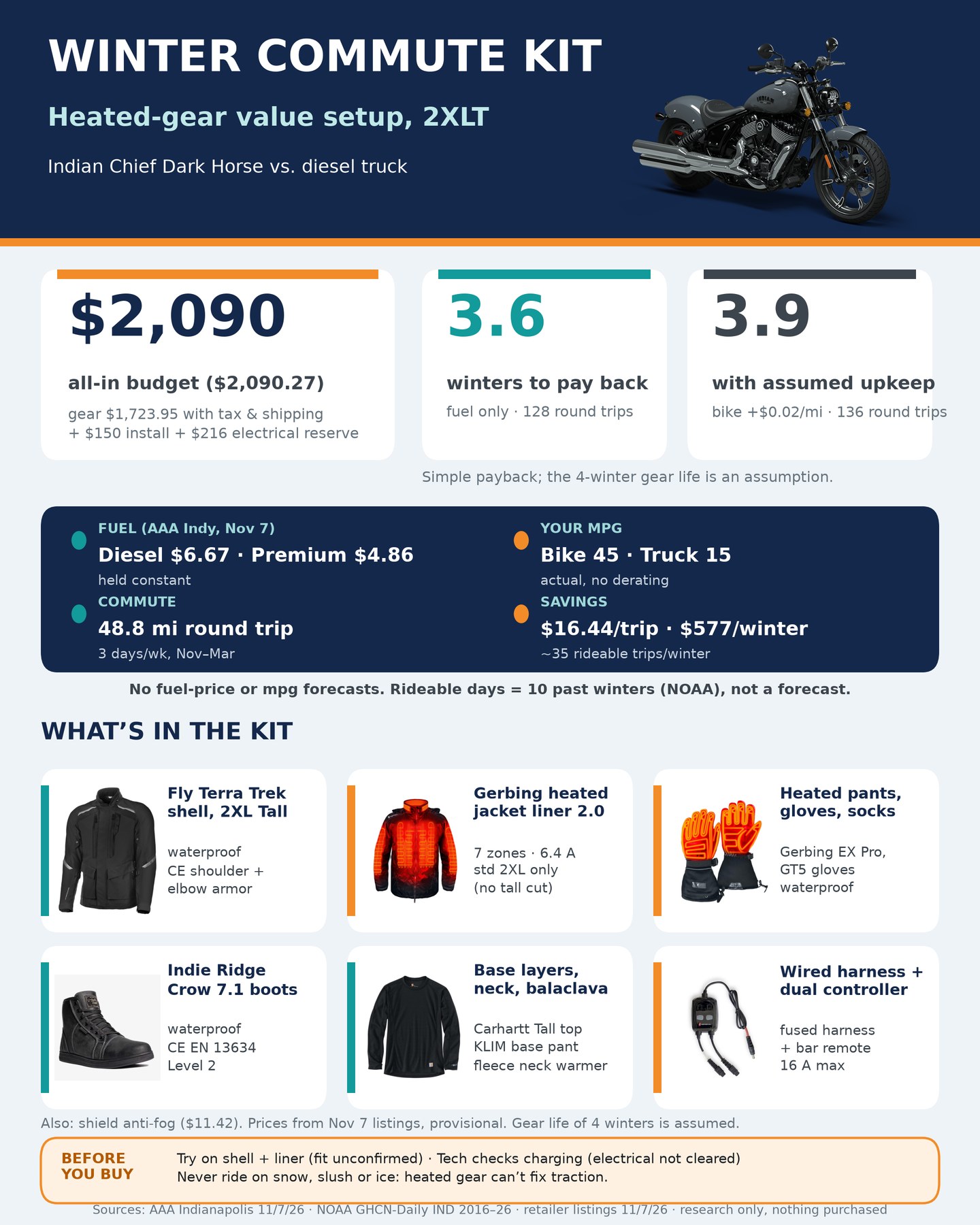
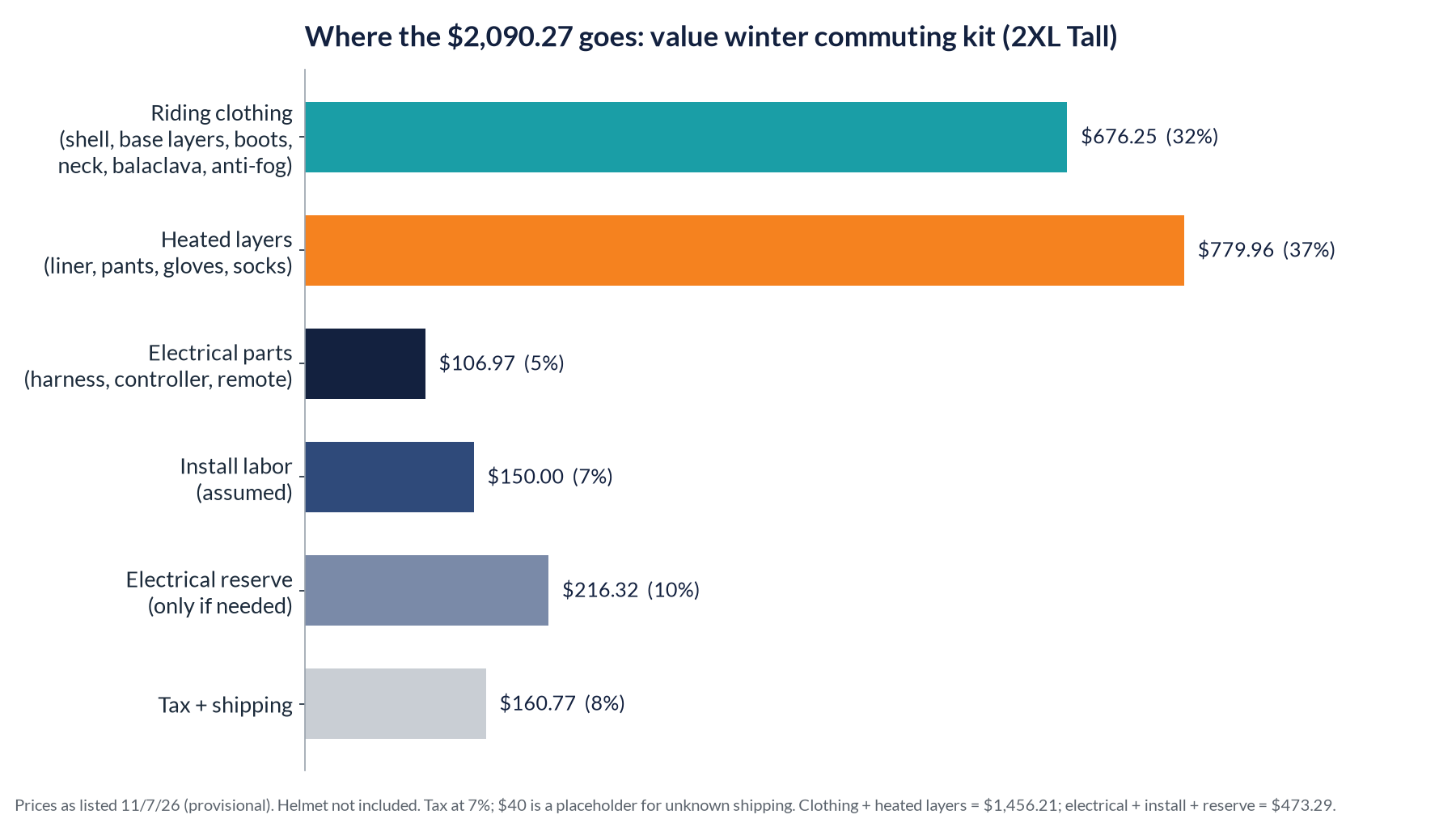
That’s $1,563.18 in items. Add $47.99 for shipping (some known, some a placeholder because a few stores don’t show it until checkout) and 7% sales tax, and the gear comes to $1,723.95. Then Shoop added two things I wouldn’t have thought to budget: $150 for a tech to install the harness and $216.32 as an electrical reserve (a second controller, a second harness and about an hour of labor) in case the shop says the load needs to be split. That brings the planning number to $2,090.27.
A note for the tall guys
This was the part that surprised me. Finding a 2XL Tall waterproof shell was doable. The Fly Racing Terra Trek and the KLIM Badlands Pro both come in a tall. But the Gerbing heated jacket liner does not come in a tall at all. A standard 2XL liner under a tall shell may come up short in the sleeves and torso, and that matters because the heated gloves plug in right at the liner cuff.
And don’t size the liner up just to get length. A loose liner puts the heat an inch away from your body, which kind of defeats the purpose. The real answer is boring but right: try the shell and liner on together before you buy either one.
The premium upgrade path: about $4,229 all in
If comfort and protection matter more to you than payback, here’s what changes. The heated gloves, socks, controller, harness, remote, neck warmer, balaclava and tall base layer top all stay the same.
| Type | Item | Store | Price | Notes |
|---|---|---|---|---|
| Outer shell | KLIM Badlands Pro Jacket, Black 2XL Tall | RevZilla | $1,319.99 | GORE-TEX Pro, CE Level 2 armor. Replaces the Fly jacket. |
| Outer pants | KLIM Latitude Pant | KLIM | $729.99 | GORE-TEX, CE Level 1 knee and hip armor. |
| Heated layer | Gerbing 12V Heated Pant Liner | Gerbing | $199.99 | Goes under the KLIM pant instead of the EX Pro pants. |
| Boots | Sidi Adventure 2 GORE-TEX | Cycle Gear | $449.99 | Taller, stiffer adventure boot. |
| Base layer | KLIM Aggressor Pant 3.0 | KLIM | $99.99 | Heavier base layer pant. |
| Visor | Pinlock insert (only if your shield is Pinlock ready) | RevZilla | $34.99 | Helmet specific, so this links to the shield and visor section. |
All in, the premium build plans out at $4,228.76. It’s a beautiful setup. It is also a very different financial story, which you’ll see in a minute.
Optional add-ons worth knowing about
| Type | Item | Store | Price | Notes |
|---|---|---|---|---|
| Hip armor | Knox Action Pro MK2 Armored Shorts | RevZilla | $129.99 | Adds hip armor to the value build. Out of stock when checked. |
| Gloves | Oxford Rainseal Pro Over Gloves | Kimpex | $20.99 | Budget option if you keep older water-resistant heated gloves. |
| Wind | Indian 17.8 in. Quick Release Low Windshield | Rider Market | $529.99 | Fits the 2022 and newer Chief. |
| Wind | Indian Quick Release Windshield Mount Kit | Rider Market | $219.99 | Needed with that windshield on a Chief. |
A windshield would make a real difference on a Chief in January, but with the mount, tax and shipping it’s about $813.18, so it’s not in the payback math. Neither is the Knox hip armor ($139.09 with tax), but I’d seriously think about it, since the EX Pro pants only have knee armor.
Can a motorcycle charging system handle heated gear?
This is the part most people skip, and it’s the part that can leave you stranded on a cold morning.
Every heated piece pulls current. Here’s how the value kit adds up on Gerbing’s own numbers at 12 volts:
| Piece | Draw |
|---|---|
| Heated jacket liner | 6.4 A |
| EX Pro heated pants | 3.6 A |
| GT5 gloves (pair) | 2.2 A |
| Heated socks (pair) | 2.0 A |
| Total | 14.2 A (about 170 W) |
Gerbing’s dual controller tops out at 192 W, or 16 A, for one rider. So the value kit fits with 1.8 A to spare. The premium kit, with the pant liner instead of the EX Pro pants, comes to 15.2 A on paper. But the pant liner page also lists 77 W, which would push the premium kit to roughly 17 A, over the controller’s max. That one is still unresolved.
Then there’s the bike. Here’s what Shoop dug out of the Indian manuals:
- The Chief’s charging system breaks even at about 1,500 rpm. Idle is 900.
- In 6th gear, 40 mph is about 1,490 rpm, 45 mph is about 1,670, and 55 mph is about 2,045. So slow cruising in top gear sits right on the line.
- Indian doesn’t publish the bike’s base electrical load, so nobody can tell you exactly how much spare capacity there is.
- Indian’s manual says to wire accessories to the load side of the main circuit breaker with ground at the engine ground. Don’t run heated gear through the 10 A power points.
So here’s my plan. A qualified tech installs the fused harness where Indian says to, routes it away from the exhaust and steering stops, and then checks the charging voltage with everything plugged in at full heat, both at idle and at commute speeds. Indian’s own service bulletin puts the healthy range at 13.4 to 14.8 volts. If it passes, great. If it doesn’t, no amount of money in that reserve line fixes a charging system that can’t keep up. And a battery tender is not a substitute.
One more good habit from Gerbing: engine on before the heat goes on, and heat off before the engine goes off.
How many days can you actually ride a motorcycle in an Indiana winter?
This was the question I was most curious about. Shoop pulled ten winters of daily NOAA weather data from the Indianapolis airport, November 1 through March 31, from 2016 through this past spring.
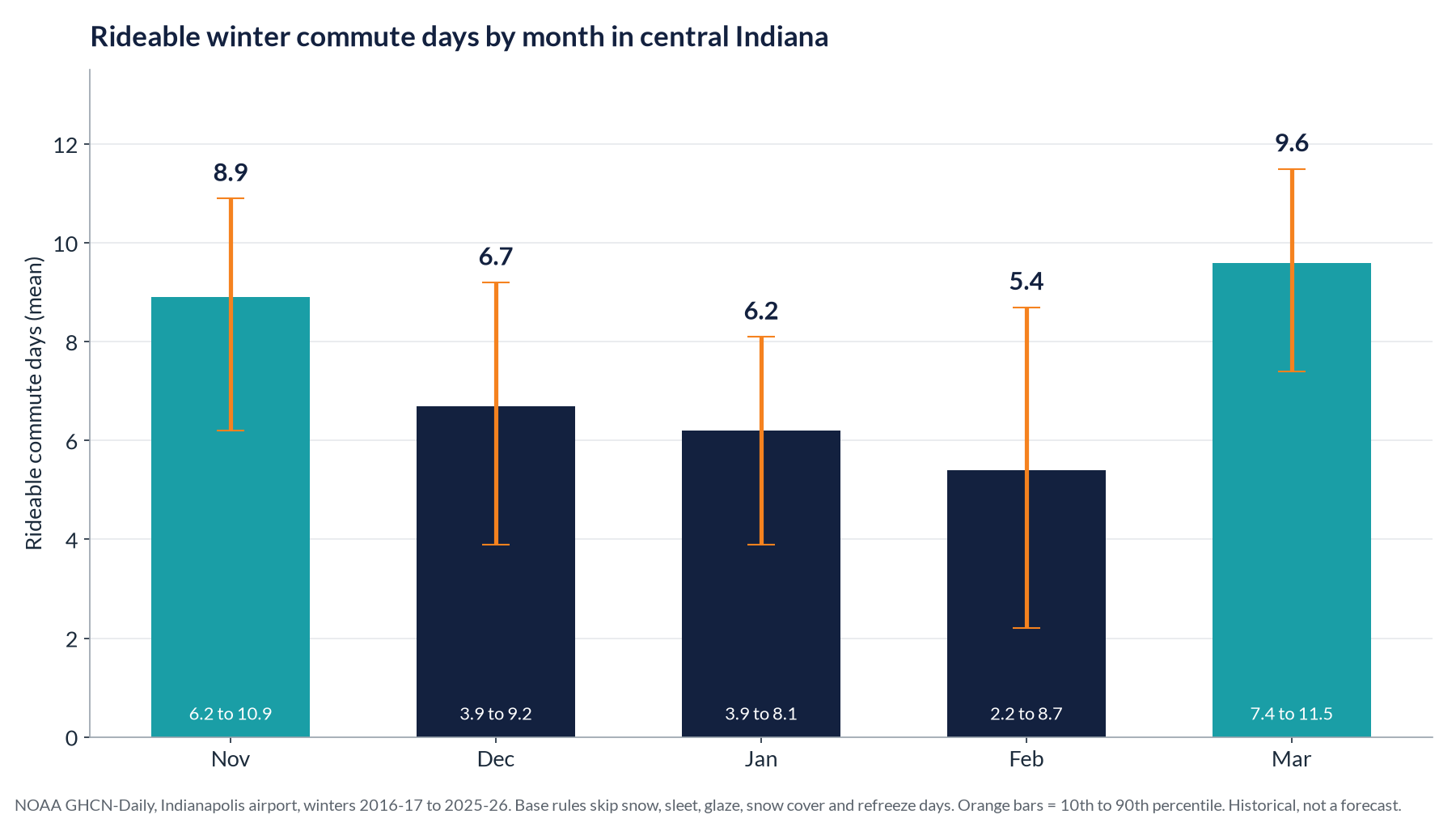
He started with my real schedule. Three commute days a week, minus holidays and a few vacation days, works out to about 57.8 planned commutes in a winter. Then he knocked out every day that had snow, sleet or glaze, snow on the ground, snow the day before, or a refreeze risk (wet roads with a low at or below 32°F).
What’s left is about 35 rideable round trips in an average winter. That’s 35.07 if you like decimals, and I do.
| Weather rules | Average rides per winter | Range over 10 winters |
|---|---|---|
| Optimistic | 49.4 | 43.9 to 55.4 |
| Base (what I use) | 35.1 | 26.0 to 45.0 |
| Conservative | 26.9 | 19.0 to 36.5 |
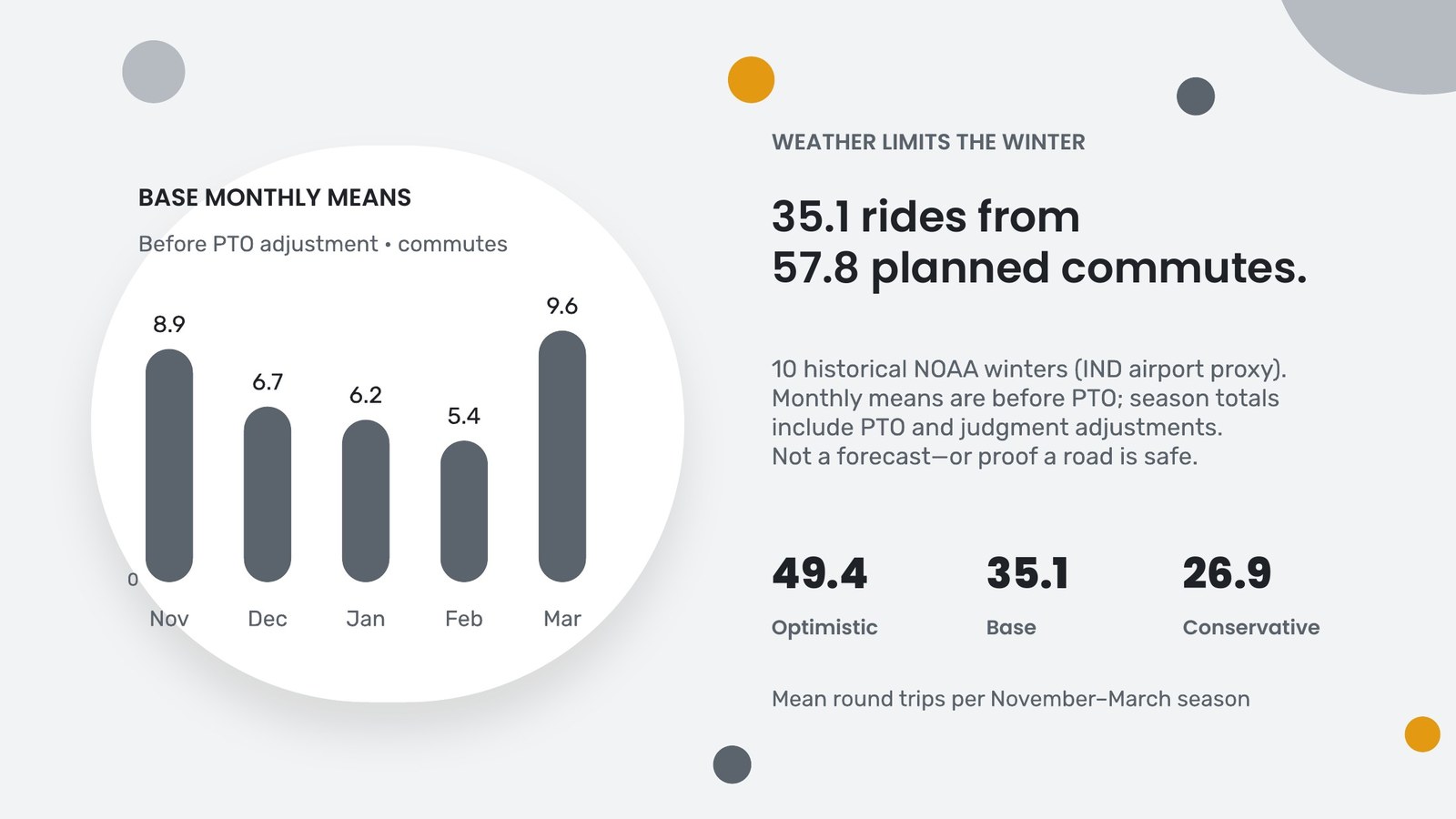
A couple of honest caveats. The airport is about 20 miles from home, and country roads stay slick longer than airport runways. And history is not a forecast. It doesn’t tell you any particular morning is safe. Every day I’ll still check the National Weather Service, INDOT TrafficWise and, most importantly, my own driveway.
Heated motorcycle gear break-even: the math
Alright. The finish line. Does it pay for itself?
Here are the inputs. No forecasting, no guessing where fuel prices are headed. Just today’s numbers held steady:
- Diesel: $6.67 a gallon and premium: $4.86 (AAA, Indianapolis metro, November 7, 2026)
- Truck: 15 mpg. Bike: 45 mpg. Those are my real numbers.
- Round trip: 48.8 miles
- Rideable round trips: about 35 per winter
The truck costs about 44.5 cents a mile in fuel. The bike costs about 10.8 cents. That’s a savings of $0.337 per mile, which is $16.44 every round trip and about $576.66 per winter.
Divide the $2,090.27 value kit by $576.66 a winter and you get:
3.62 winters to break even. That’s 128 round trips on the bike.
If you add in an assumed upkeep difference (the bike eats tires and oil changes, salt care isn’t free, and you’re also saving wear on the truck), the bike comes out about 2 cents a mile more expensive. That nudges it to 3.85 winters, or 136 round trips.
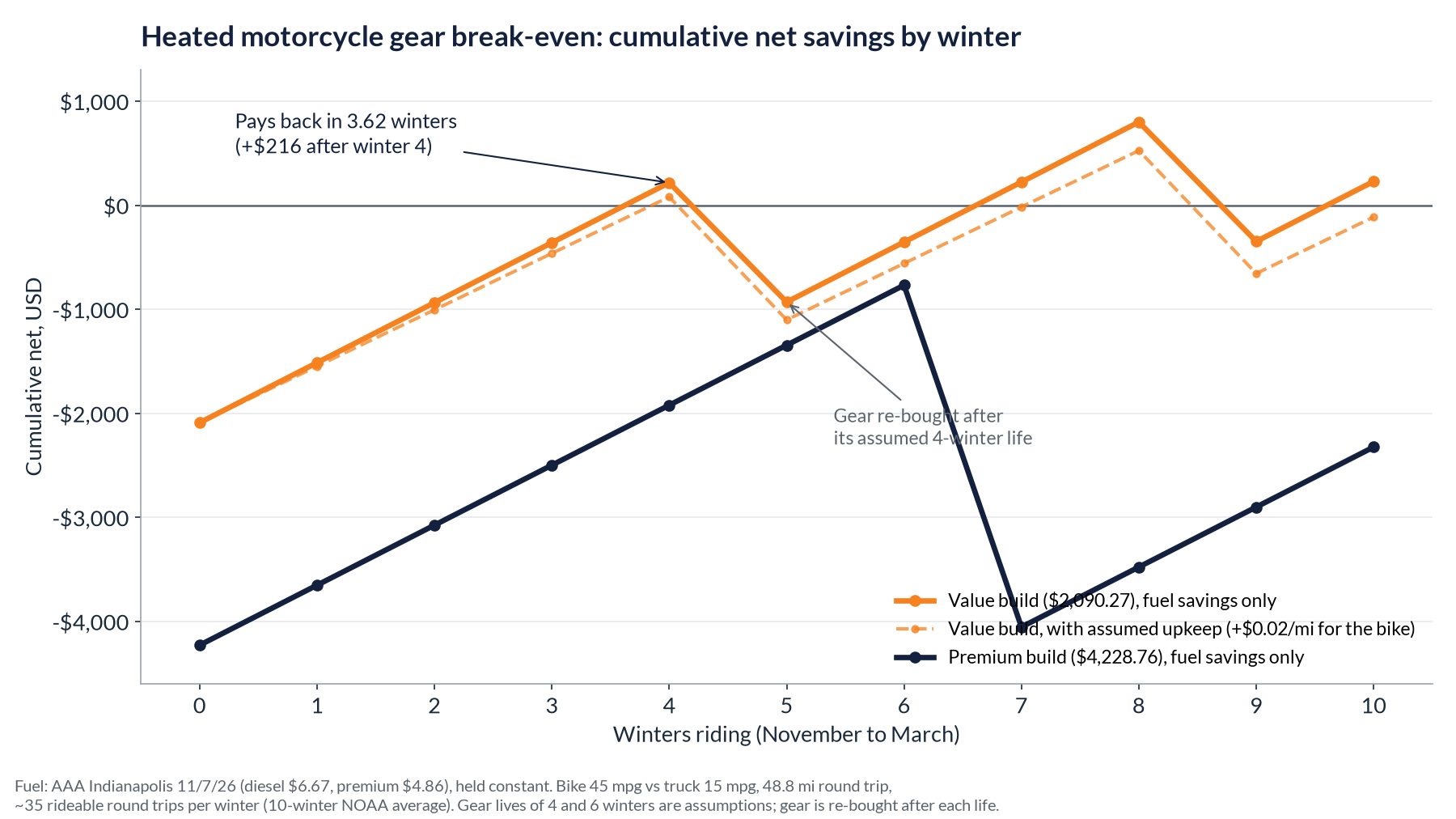
Shoop assumed the value gear lasts four winters, which is a guess, since he couldn’t find real lifespan data on this stuff. On that assumption, I’m about $216 ahead at the end of winter four on fuel alone, or about $79 ahead with upkeep. Then I’d buy new gear and start the climb again.
The premium kit is a different animal. It takes 7.33 winters to pay back on fuel alone, and Shoop assumed it lasts six. So at the end of its life it’s about $769 in the hole. That doesn’t make it a bad purchase. It just means you buy it for comfort and protection, not to save money.
| Build | All in | Payback, fuel only | Payback, with upkeep | Net at end of gear life |
|---|---|---|---|---|
| Value, 2XL Tall | $2,090.27 | 3.62 winters (128 trips) | 3.85 (136) | +$216 (4 winters) |
| Premium, 2XL Tall | $4,228.76 | 7.33 winters (258 trips) | 7.80 (274) | -$769 (6 winters) |
| Value, standard 2XL | $1,769.32 | 3.07 winters (108 trips) | 3.26 (115) | +$537 (4 winters) |
| Premium, standard 2XL | $3,522.56 | 6.11 winters (215 trips) | 6.49 (228) | -$63 (6 winters) |
The standard 2XL rows are cheaper because they swap in Gerbing’s EX Pro jacket (no tall) and a KLIM base layer. For a tall guy, that’s a fit gamble.
What could change the answer
Here’s the sensitivity, because one number never tells the whole story.
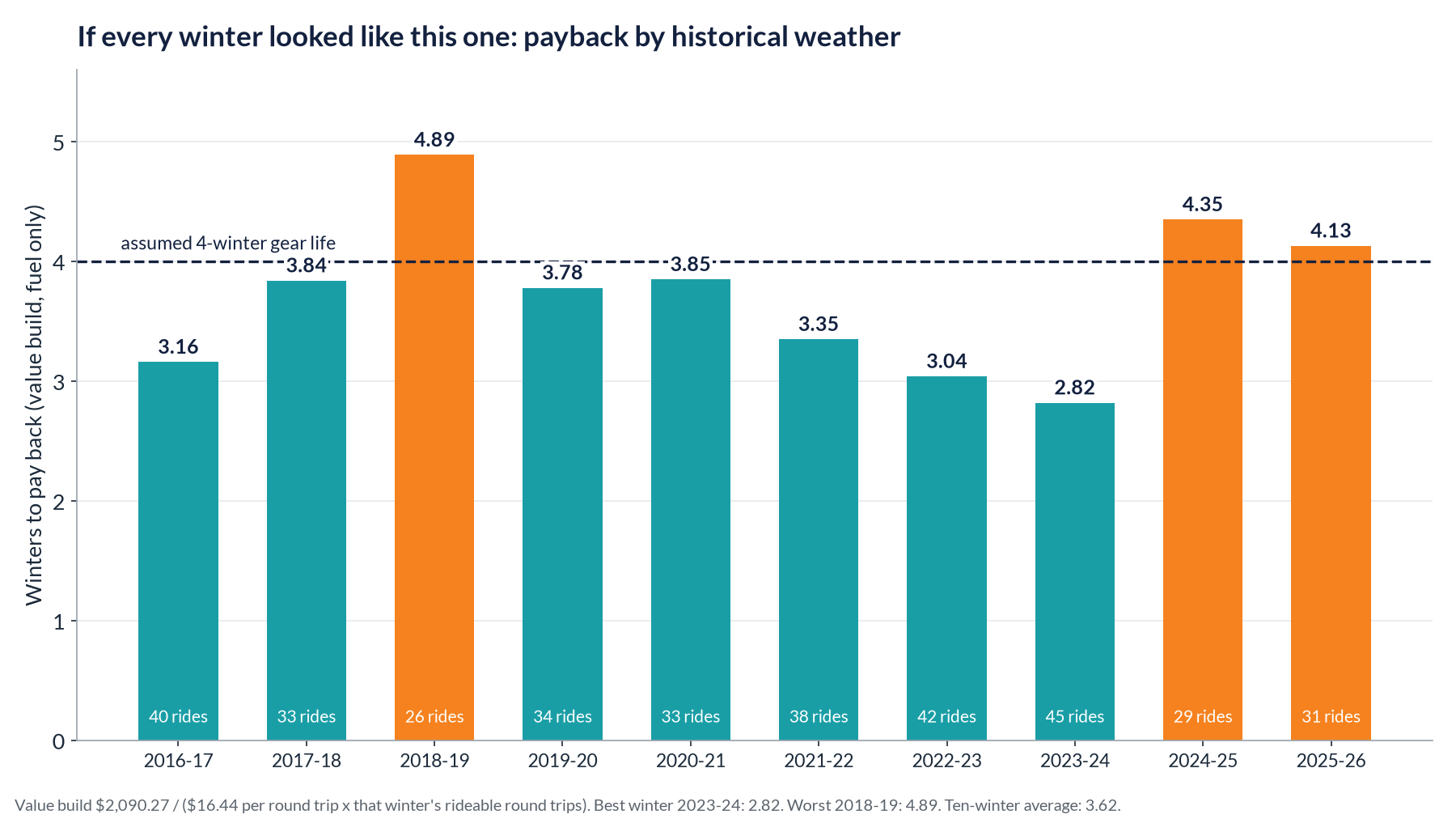
- Weather. In the best winter of the last ten (2023 to 2024, 45 rides), the value kit would pay back in 2.82 winters. In the worst (2018 to 2019, 26 rides), it takes 4.89. The middle of the pack runs 3.02 to 4.40.
- Diesel prices. Diesel is unusually high right now. A year ago it was $3.87 in Indy with premium at $4.15. At those prices the savings drop to about $8.08 a round trip, and payback stretches to roughly 7.4 winters, well past the gear’s life. This only works while diesel stays expensive.
- Distance. If my real door to door trip is closer to 30 miles each way, savings jump to about $20.22 a round trip. I need to check the odometer.
- Gear life. If the gear lasts longer than four winters, the picture gets better fast. If it wears out sooner, worse.
Download the full guide
I had all of this turned into a free 9 page PDF: the full gear list with links, the electrical checklist for your mechanic, the weather method, the break-even tables and a morning go or no-go checklist. Print it, hand it to your shop, or stick it on the garage wall.
Frequently asked questions about winter motorcycle commuting
Is heated motorcycle gear worth it for commuting?
For me, on the value kit, the numbers say yes, barely, as long as diesel stays high. It pays back in about 3.6 winters against a 15 mpg diesel truck at today’s prices, inside its assumed four winter life. The premium kit doesn’t pay for itself on fuel. The bigger payoff is honestly the riding itself.
How many days can you ride a motorcycle in an Indiana winter?
Based on ten winters of NOAA data at the Indianapolis airport, about 35 of my roughly 58 planned November to March commute days were clear of snow, ice and refreeze risk. That ranged from 26 in a rough winter to 45 in a mild one. November and March are the best months. February is the worst.
Can my motorcycle’s charging system handle heated gear?
Maybe. A full heated set like this draws about 14 to 15 amps. On my Chief, the charging system breaks even around 1,500 rpm, which is right about 40 mph in 6th gear. Have a tech install the harness where your manufacturer specifies and test the charging voltage with all your gear on full heat before you depend on it.
Does heated gear make winter riding safe?
No. It makes it comfortable. Traction is the danger in winter, and heated gear does nothing for traction. I don’t ride on snow, ice, slush, brine or refreeze days.
Where do you plug in heated motorcycle gear?
Gerbing’s setup uses one fused battery harness and a dual controller. The gloves plug into the jacket liner sleeves, the socks plug into the pants, and the pants plug into the jacket. On an Indian Chief, the owner’s manual says to wire accessories to the load side of the main circuit breaker rather than the 10 A power points.
Can tall riders find heated motorcycle gear that fits?
Partly. Some waterproof shells, like the Fly Racing Terra Trek and KLIM Badlands Pro, come in tall sizes. Gerbing’s heated jacket liner does not. Try the shell and liner on together, and don’t size the liner up just for length.
Counting the cost
There’s a line from Jesus in Luke 14 that keeps rattling around in my head while I look at all these charts. He says nobody builds a tower without first sitting down to count the cost, to see if he has enough to finish it.
That’s what this whole project has been. Sitting down and counting the cost before I start building. Not just the dollars, either. The cost of a tech’s time. The cost of being disciplined enough to take the truck on the mornings I really want to ride. The cost of saying no when the road says no.
And when I count it all up, I like where this lands. The value kit pays for itself in under four winters if diesel stays where it is. If it doesn’t, I still got a few dozen more mornings a year with a clear head, a cold face, and a sunrise I’d otherwise watch through glass.
Ecclesiastes says there’s a season for everything. For a long time I thought winter was the season for parking the bike. Turns out it might just be the season for riding a little smarter.
See you out there. Probably bundled up and waving like an idiot at the gas station.
