

It is easy, and important, to put something in a brand tone guide. The words look right. They sound like who we want to be. Writing them down is the easy part. Now we have to act them out.
We already had the lines. “We don’t seek conflict, but we also don’t ignore it.” And, “We’re conversational, but we put important things in writing.” I like both of those. I still do. They are also easy to agree with in a quiet room, and easier to set aside when a real problem lands.
I started noticing something I did not like. It was not a crisis. It was smaller than that, and that was the point. Little problems could sit without a clear owner. Nobody was trying to hide from the work. It was more ordinary than that. A question would come in. A few people would touch it. Each person thought someone else was carrying it. And a simple thing got older than it needed to.
That is how piles start. Not with one big mess, but with a few small ones that never quite belonged to anybody.
I did not want to wait for a hard day to invent a habit. If we only practice this when the stakes are high, we will be clumsy when it matters most. So I asked our team to build the habit now, while the problems are still small.
What I asked of us
Here is what I asked of them, and of myself.
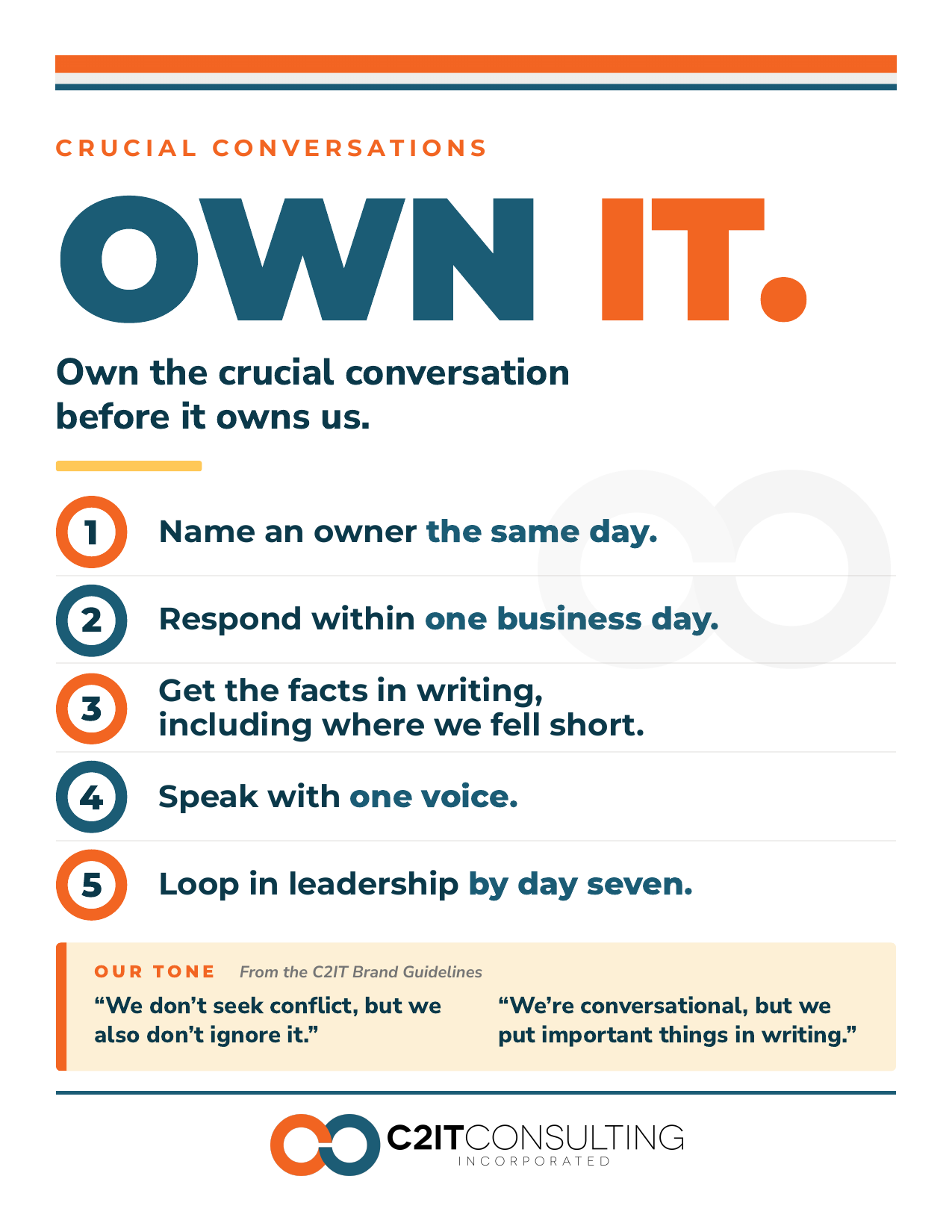
Someone owns every issue the same day it shows up. The customer hears back within a day, even if the full answer is not ready yet. And if something is still open after a week, it comes to me.
That is not a thick process. It is a promise about time and ownership. Somebody’s name goes on it today. The other person is not left wondering. And I do not find out about a stuck problem after it has already gotten worse.
An ordinary Tuesday
The real test is not the wording. It is an ordinary Tuesday afternoon.
A message comes in. Maybe it is a little tense. Maybe someone is disappointed, or confused, or waiting on an answer we should have already given. It would be easy to tell ourselves we will get to it tomorrow. It would be easy to talk it through in the hallway and leave it there.
We don’t seek conflict, but we also don’t ignore it. Ignoring it can look polite. It can look like hoping things cool off. It can look like staying busy with easier work.
Acting it out looks different. It looks like naming an owner before the day is over. It looks like a real reply, even if that reply is simply that we have it, and when they will hear from us next. It looks like writing down the important parts, even when the conversation was casual. A hallway chat can feel finished in the moment. Then two people remember it two different ways, and the problem gets a second life. A short note does not make us stiff. It keeps us honest.
I have to be honest about my own part in this.
I am the leader, and I have let things slide. Not because I did not care. A small issue can look like it will resolve itself. A hard conversation is easier to postpone than to have. I know what it feels like to protect the peace in the room and call it patience. Sometimes it is patience. Sometimes it is just avoidance in a nicer shirt.
If I want this to stick, I do not get to point at a guide and walk away. I have to own the issues that come to me. I have to have the conversations I would rather put off. And I have to admit it when I am the one who let something sit.
People will not remember the wording in a tone guide as much as they will remember what we did when something went wrong. They believe what you do, not what is on the wall.
A few years from now, I hope my team can say we handled problems while they were still small. That someone always owned them. That customers heard from us quickly, and honestly. And that I did not wait for a crisis to start acting like the kind of leader I already said I wanted to be.
The habit starts now, before it matters most.
